One Pipeline, Many Products: How We Ship Apps With AI (and Keep a Human Gate)
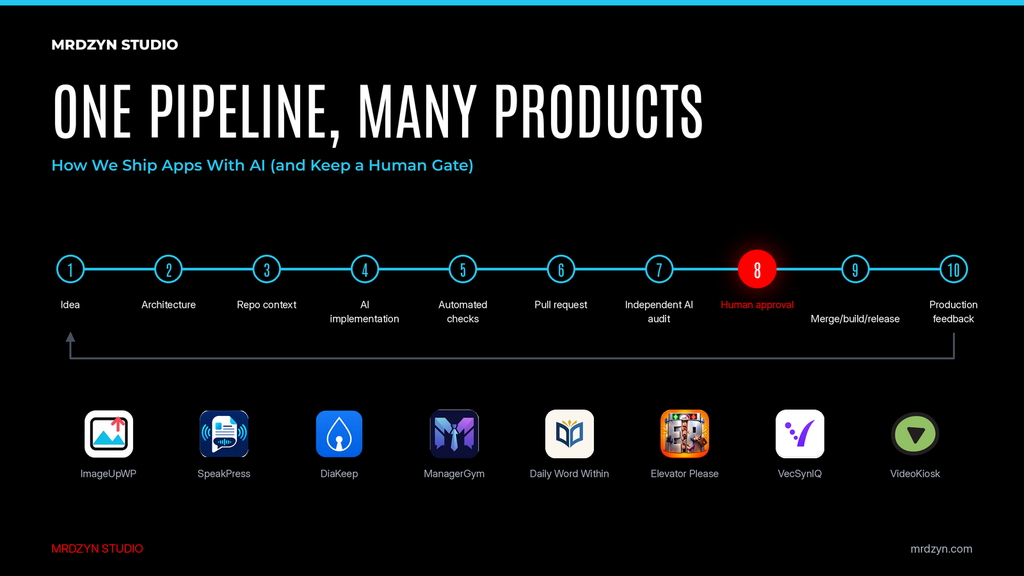
Not long ago, AI was something we used to help write code. Today it sits inside a full delivery pipeline, and a human still signs off on everything that ships.
That shift happened faster than we expected. And the most useful lesson from it isn't about code generation at all.
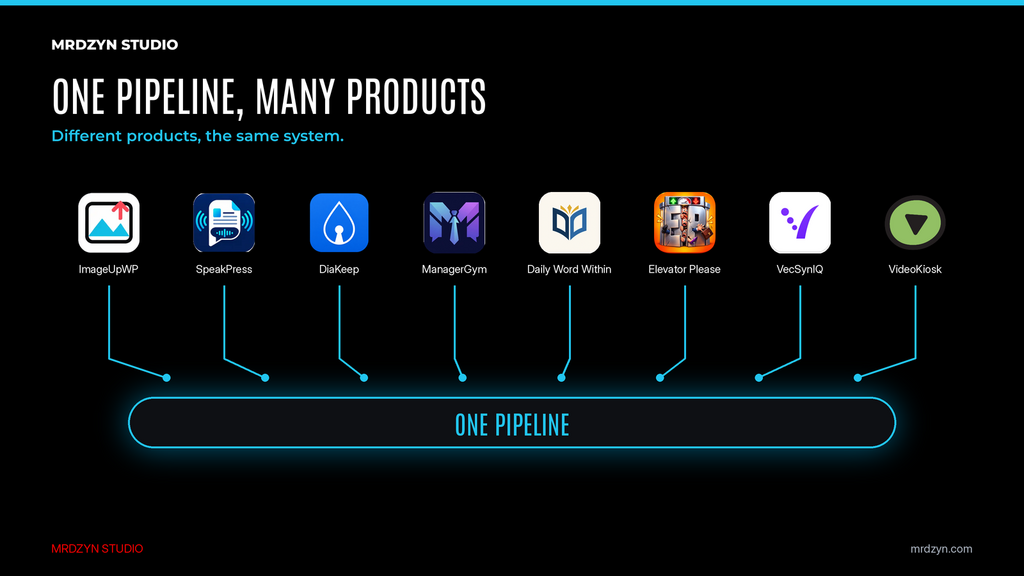
Different products, the same system
Recently, Mrdzyn Studio has built and shipped ImageUpWP, SpeakPress, DiaKeep, ManagerGym, Daily Word Within, Elevator Please, VecSynIQ, VideoKiosk and the VideoKiosk MCP server.
We built products we knew we'd use ourselves and that others would find useful: a Chrome extension, a WordPress plugin, multiplatform mobile apps built with Flutter, React Native and Kotlin, and SaaS built with Node, Vite and TypeScript. If a stack is secure and well supported, we'll build on it.
But increasingly, the same delivery system sits behind all of them.
The pipeline, step by step
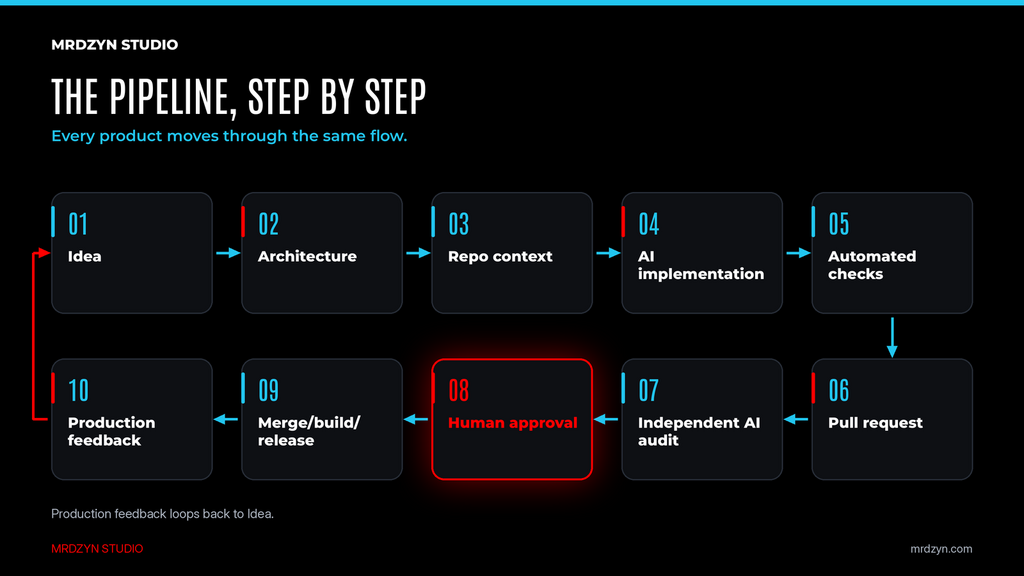
Here's the flow every product moves through:
- Idea. A workflow that's too slow, too scattered or too expensive.
- Architecture. A human decides the shape of the system before any code is written.
- Repo context. Documentation lives in the repository, so every agent starts with the same picture of the project.
- AI implementation. An AI agent writes the change.
- Automated checks. Tests and checks run on every change.
- Pull request. The work lands as a reviewable PR, so GitHub becomes the control layer.
- Independent AI audit. A second AI agent, separate from the one that wrote the code, audits the pull request.
- Human approval. A person reviews and decides.
- Merge, build, release. Approved work goes out.
- Production feedback. What happens in the real world feeds the next idea.
In practice, it starts before any code. We use AI chat tools to refine the idea and prepare the execution plan. Then we hand off to a coding agent, which could be Claude, Codex, Gemini, Grok or Muse Code.
One agent implements, another reviews
AI coding is only one small part of the story. The bigger opportunity is what happens when AI agents take part in the whole software lifecycle.
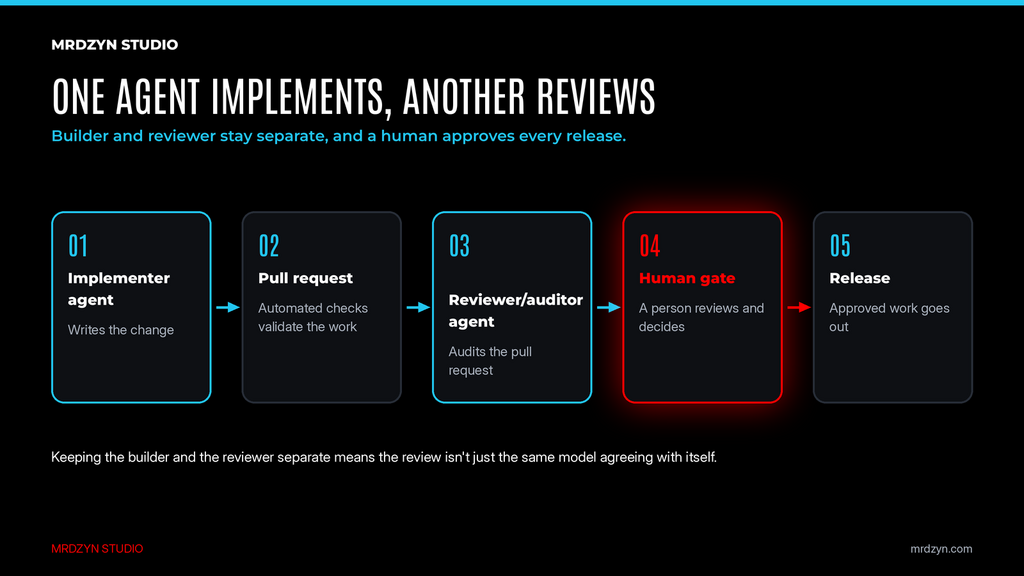
In our setup, roles are split on purpose. One agent implements. A different agent reviews and audits. Automated checks validate the work. Keeping the builder and the reviewer separate means the review isn't just the same model agreeing with itself.
Practical tip: if you only take one idea from this post, separate the agent that writes code from the agent that reviews it, and make the review show up as written comments on the pull request where you can read it.
This has paid off. The independent audits have caught plenty of security gaps that would otherwise have gone out to production.
Why we keep the human gate
We're deliberately keeping a human in charge of architecture, product direction, risk, security and release decisions.
Faster delivery is useful. Faster delivery without accountability is not.
An AI agent can write a feature in minutes. It can't own the call on whether that feature is safe to ship to people's devices, how it handles their data, or whether it matches where the product should go. Those decisions stay with a person, and the pipeline is built so nothing reaches production without that sign-off.
The real gain is repeatability
What surprised us most is that the biggest productivity gain hasn't come from generating code faster.
It has come from making the process repeatable.
We can move from an idea to a working application, plugin, SaaS product, mobile app, game or integration using roughly the same engineering flow every time. You don't reinvent how you build, test and release for each new project. You just point the same system at a new problem.
That changes the economics of building software. A small studio can maintain a portfolio of products instead of one, because the hard part (the process) is already solved.
With this pipeline, ideas become working products in days, not months.
Practical tips if you're building with AI
- Put context in the repo. Agents work better when architecture notes and decisions live next to the code, not in someone's head.
- Make the pull request the checkpoint. Every change, from a human or an agent, goes through the same review gate.
- Split roles. Implementer, reviewer and auditor shouldn't be the same agent run.
- Automate the boring checks. Let tests and checks catch the obvious problems so human review can focus on judgment calls.
- Keep release decisions human. Speed is a tool, not the goal.
What's next
We're standardizing this even further: reusable CI/CD workflows, standard project templates, structured tasks for AI agents, dedicated implementer, reviewer and auditor roles, automated quality gates, and dev to staging to production promotion. After that comes release automation, observability, and eventually one control plane across the whole product portfolio.
The direction feels pretty clear.
Build with us
If you're sitting on an idea, or an AI-built prototype that needs a real path to production, we'd love to talk about how this pipeline could work for you.
Schedule a meeting with Mrdzyn Studio, or explore the apps we've shipped with it on mrdzyn.com.