Shipping Is Half the Job: How We Run Launches and Content With an AI Agent Team (and Still Approve Everything)
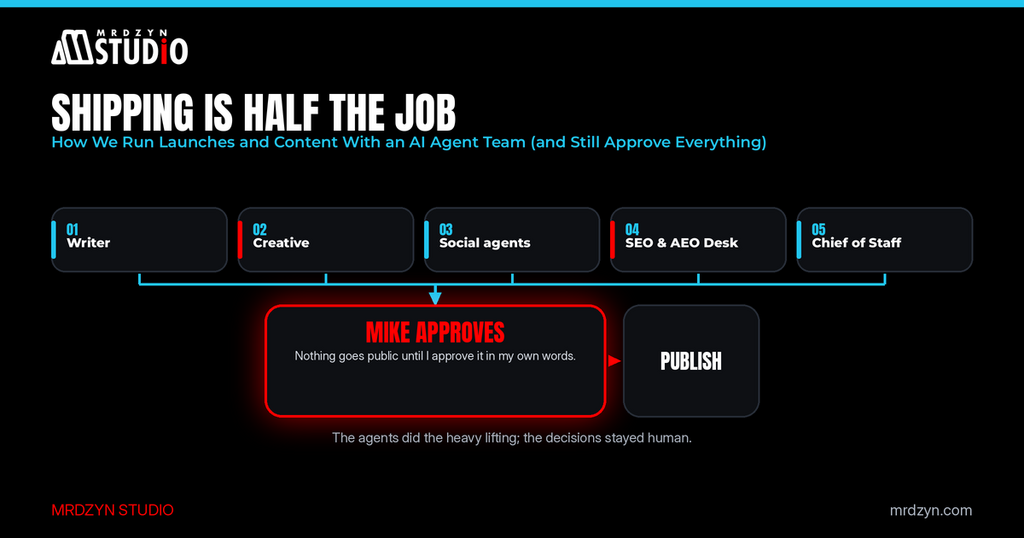
We build our apps with AI through a human-gated pipeline: one agent implements, another audits, and a person approves every release.
That pipeline gets a product into the store. It doesn't get anyone to notice it.
For a small studio with a growing portfolio (ImageUpWP, SpeakPress, DiaKeep, VideoKiosk, VecSynIQ, ManagerGym and more), the work after the merge is just as big: launch pages, blog posts, visuals, social copy, store promos, SEO fixes. So we applied the same idea to that side of the business. Here's how it works, and what we'd tell any builder trying it.
The setup: agents with one job each
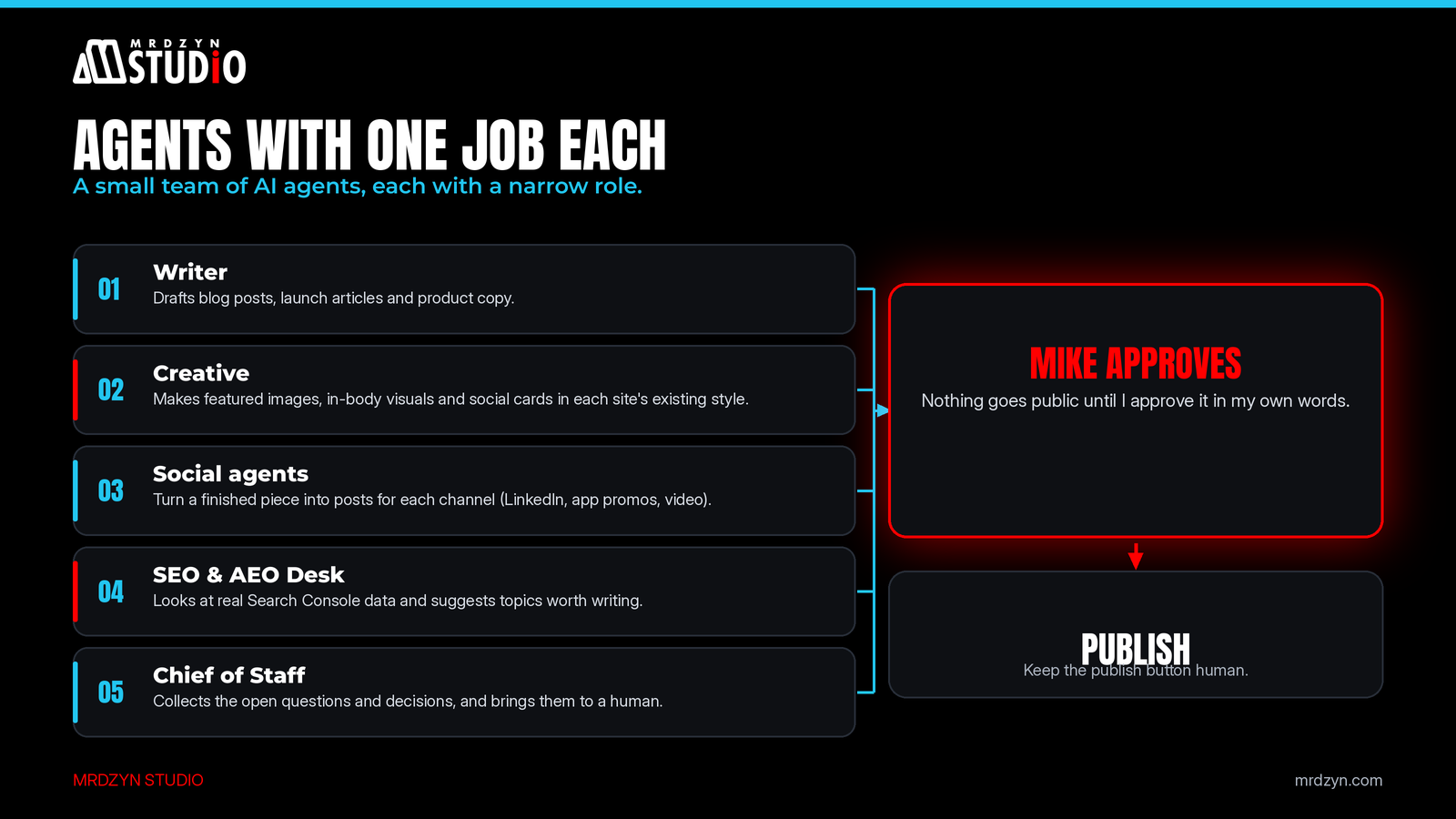
Instead of one general assistant doing everything, we run a small team of AI agents on Grok Bot, each with a narrow role:
- Writer drafts blog posts, launch articles and product copy.
- Creative makes featured images, in-body visuals and social cards in each site's existing style.
- Social agents (LinkedIn, app promos, video) turn a finished piece into posts for each channel.
- SEO & AEO desk looks at real Search Console data and suggests topics worth writing.
- Chief of Staff collects the open questions and decisions, and brings them to a human.
It's the same lesson we learned in code: split the roles. A writer that also judges its own work tends to agree with itself. A separate agent that only does visuals, or only reads search data, produces sharper output and makes it obvious who did what.
Role-based agents get the work done much faster.
A real example: the ManagerGym 2.0 launch
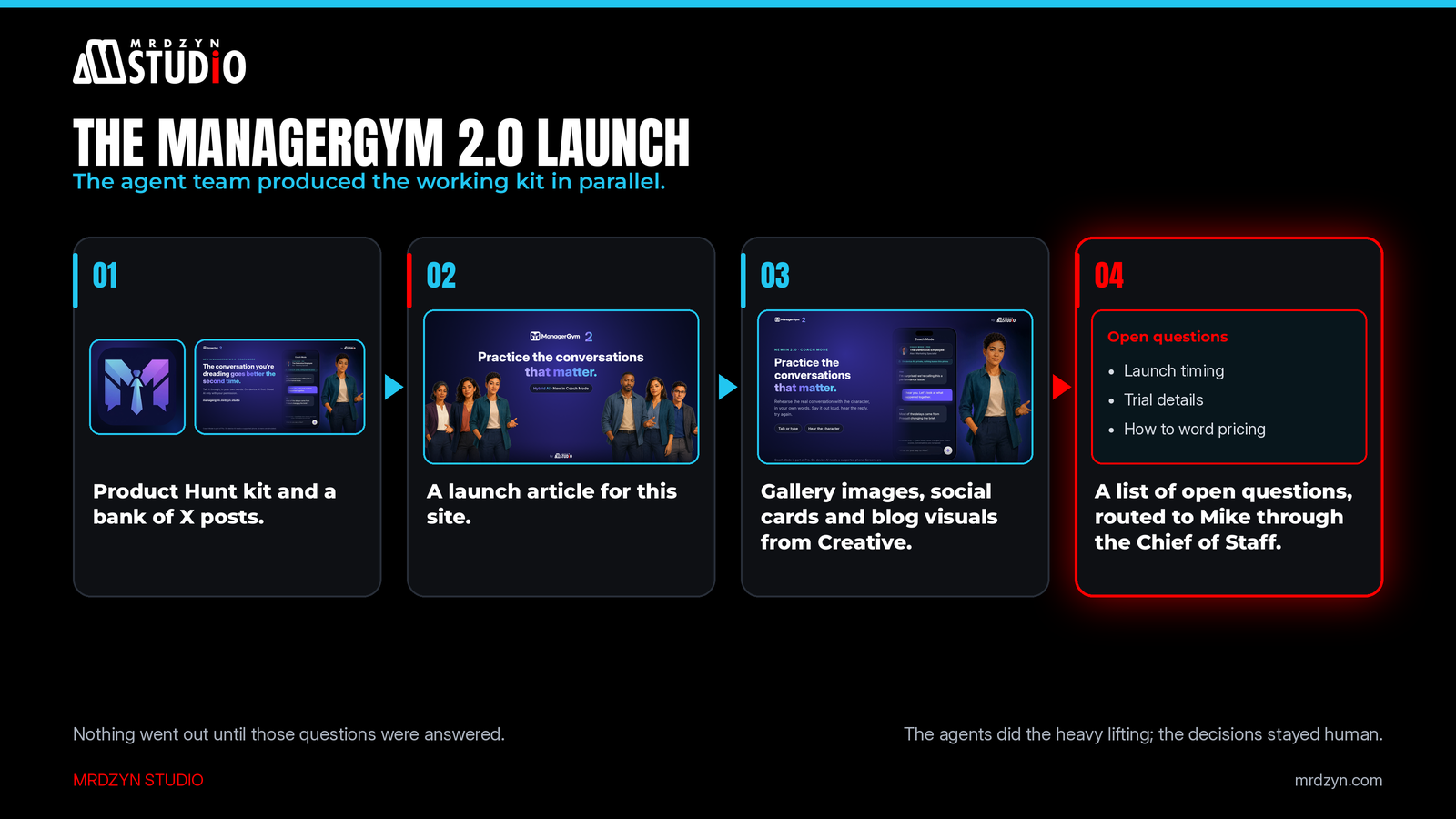
When we prepared the ManagerGym 2.0 launch on Product Hunt, the agent team produced the working kit in parallel:
- A Product Hunt kit and a bank of X posts.
- A launch article for this site.
- Gallery images, social cards and blog visuals from Creative.
- A list of open questions, such as launch timing, trial details and how to word pricing, routed to me through the Chief of Staff.
Nothing went out until those questions were answered. Placeholders like [PH_LINK] stayed in the drafts until the real link existed. The agents did the heavy lifting; the decisions stayed human.
The ManagerGym 2.0 launch was a success. A few users were curious about the launch, and we're just getting started.
Rule one: agents never invent facts
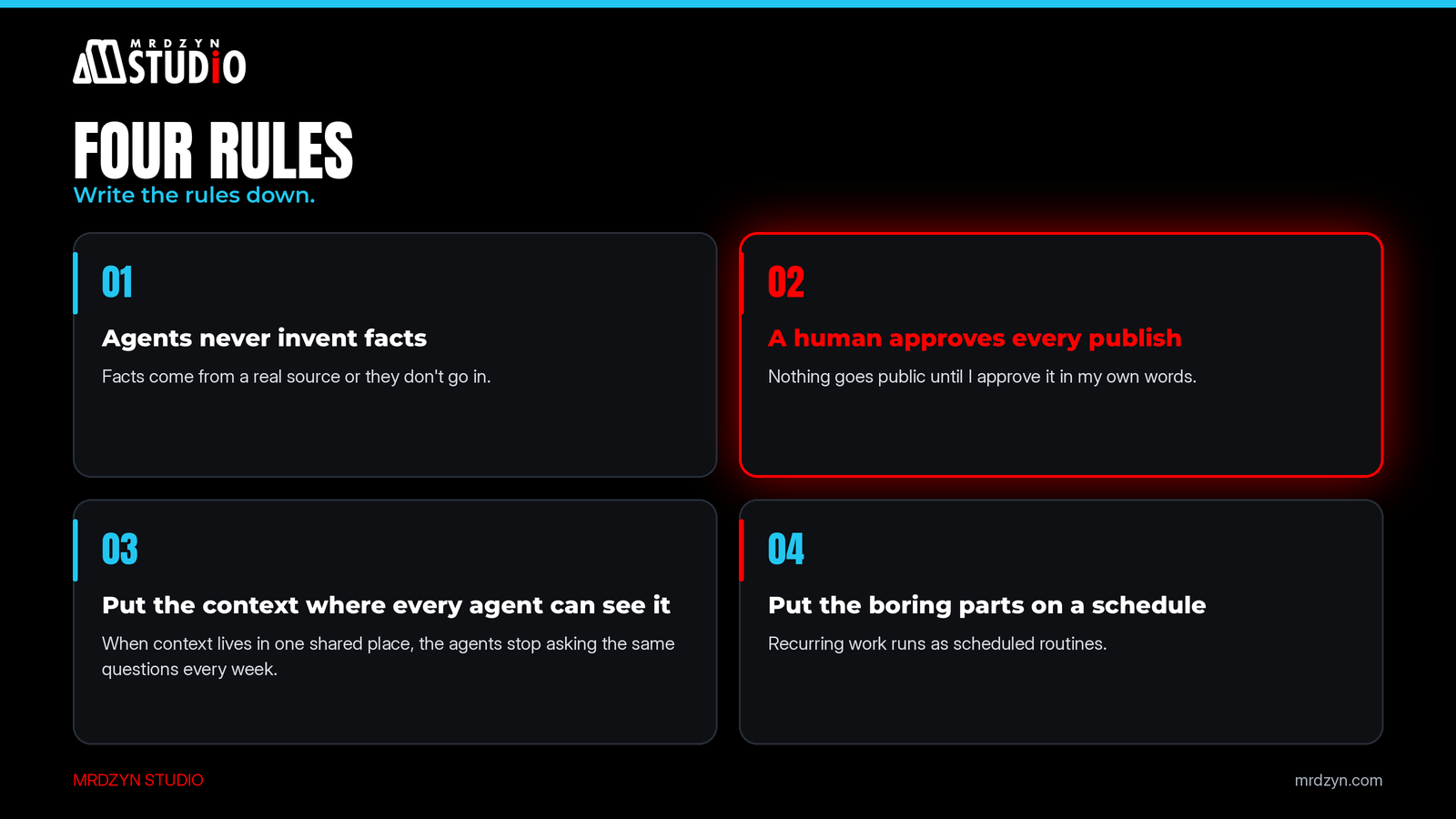
The fastest way to wreck trust is a confident blog post with a made-up stat. So our agents work under a simple rule: facts come from a real source or they don't go in.
- Product details come from the product's own live site or store listing.
- First-hand opinions and results are left as clearly marked questions for me to answer, not guessed.
- Known product facts are written down once and respected everywhere. For example, VecSynIQ is on iOS and Android, and its 3D export is a Pro feature, so no draft may imply otherwise.
This makes drafts slightly slower to finish, and far safer to publish.
Rule two: a human approves every publish
The publishing rule mirrors our release rule. Agents can draft, design and stage. Nothing goes public until I approve it in my own words.
That covers blog posts on our sites, product articles and social posts. Drafts land with their visuals attached, I read them, answer the open questions, and say "publish" or send changes. A scheduled routine isn't approval, and neither is "looks fine" from another agent.
It's the content version of keeping a human in charge of architecture, risk and releases. Speed is useful. Speed without accountability isn't.
Rule three: put the context where every agent can see it
In code, we keep documentation in the repo so every agent starts from the same picture. Content works the same way. Our agents share:
- A memory of standing decisions, such as which CTA each site uses, which features are paid-only, and which topics are already covered.
- Draft files saved with dates, so the next week's agent can check what's been written and avoid repeats.
- Series plans, so a weekly blog follows an agreed outline instead of whatever seems interesting that morning.
When context lives in one shared place, the agents stop asking the same questions every week.
Rule four: put the boring parts on a schedule
Recurring work runs as scheduled routines. This article is a good example: a weekly routine checks what's been published, picks a topic that isn't a repeat, drafts it, briefs Creative for visuals, and sends the whole package to me for review.
The agent team runs on Grok Bot. Alongside it, a few tools handle their own lane. We use Publer through its ChatGPT app to plan and schedule posts, and Noota to record meetings and send minutes into HubSpot.
Practical tips if you want to try this
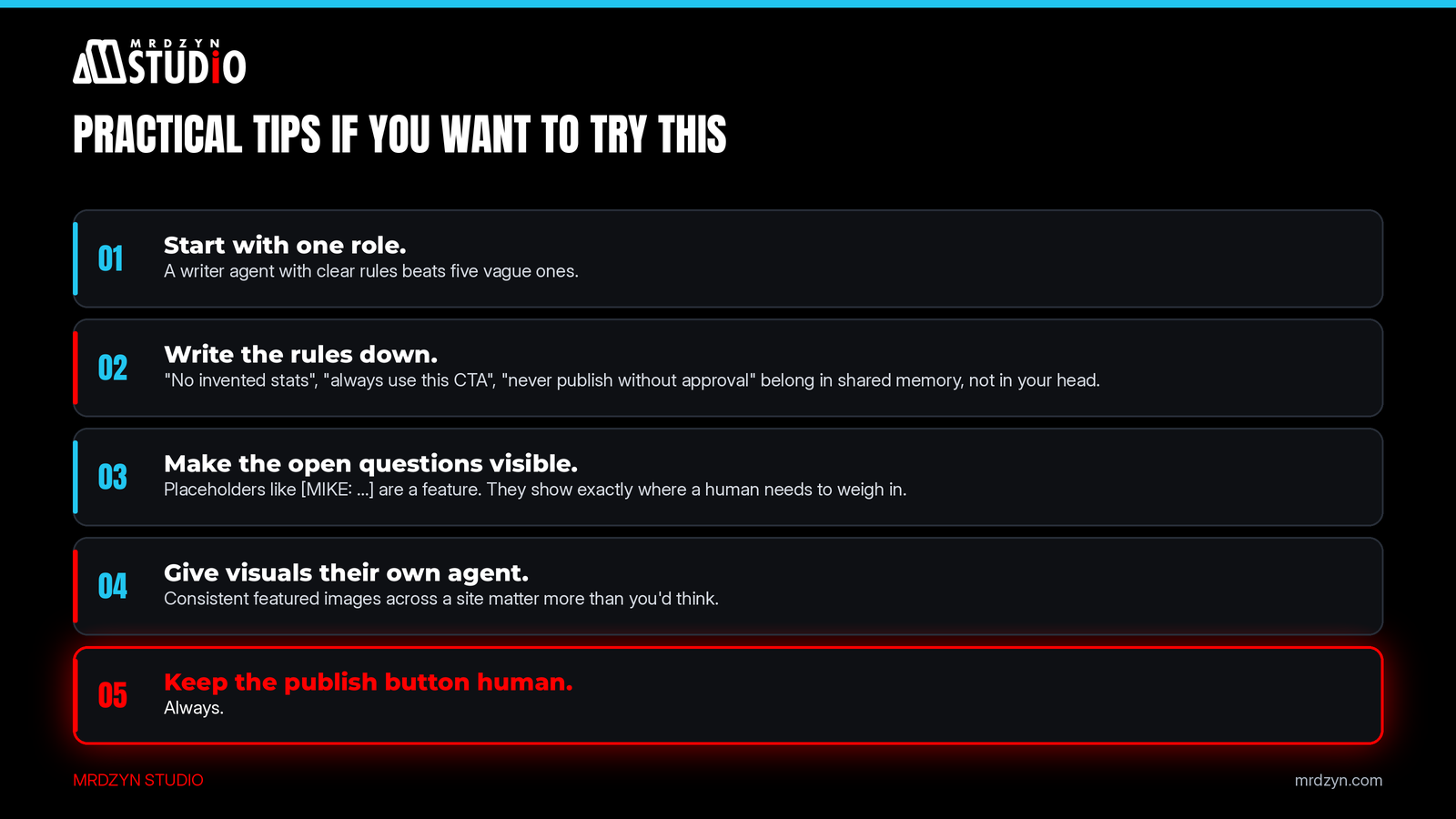
- Start with one role. A writer agent with clear rules beats five vague ones.
- Write the rules down. "No invented stats", "always use this CTA", "never publish without approval" belong in shared memory, not in your head.
- Make the open questions visible. Placeholders like
[MIKE: ...]are a feature. They show exactly where a human needs to weigh in. - Give visuals their own agent. Consistent featured images across a site matter more than you'd think.
- Keep the publish button human. Always.
Want this for your product?
We use this setup to ship and promote our own portfolio. If you're building with AI and want a clear path from prototype to a product people actually find, let's talk.
Schedule a meeting with Mrdzyn Studio, or explore the products we've shipped on mrdzyn.com.